When More Help Isn’t Better Help
Designing AI agents around what people actually want them to do.
The fastest way to complete a task isn't always the way we'd want it done.
You emailed a potential partner last week and haven’t heard back. Your inbox might already have sent you a pesky nudge: Sent five days ago. Follow up? An AI agent could even go a step further by drafting a follow-up and having it ready in seconds. The task gets done faster, and nobody has to remember to check their inbox. Helpful, in theory. But what if your delay was intentional?
This question surfaced as we explored how AI agents could take on routine (yet time-consuming) work in CURA's internal operations. A colleague explained that when reaching out to nonprofits, the team sometimes deliberately waits two weeks or longer before following up. So what would actually help in this case? An agent that remembers when to check back? Useful. One that drafts another email every time someone doesn’t reply? Not so much.
But when we talked about weekly briefings, the same colleague wanted the agent to take far more initiative: instantly gather updates from across the organisation and prepare a summary everyone can access.
Both workflows are relatively straightforward to describe. And technically, an agent could take on much of the work in either. But the more interesting design choices emerge when we consider not just what an agent can do, but what people actually want it to do.
Your Self-Determining Mind
Why does help sometimes feel like a relief, and other times like an intrusion? Part of the answer may lie in what makes us feel motivated and fulfilled in our work.
Self-Determination Theory suggests that our motivation and wellbeing are shaped by three basic psychological needs. It’s a bit like the difference between a week that leaves you drained and one that leaves you tired but satisfied, even when you’ve worked the same hours.
The three needs look like this:
- Competence: feeling capable and effective, like your effort is actually making a difference. Am I doing the work I’m good at? Am I getting anywhere, or just moving information around? Competence isn’t about being the best at something; it’s about feeling that your skills are being put to good use.
- Autonomy: feeling that you have meaningful choice in how you act. Did I decide this, or did it just happen to me? Am I acting on my own judgement? Autonomy is often confused with independence, but they’re not the same. Handing work over can feel entirely autonomous, as long as handing it over was your choice.
- Relatedness: feeling connected to the people around you, and that you matter to one another. Do I know what my colleagues are working on? Are we following through on what we promised our clients? Relatedness isn’t just about getting along; it’s about people paying real attention to each other
For those designing AI agents, these psychological needs offer a useful way to consider whether automation risks taking over the very parts of work people find meaningful. Beyond making tasks faster or easier, we can begin to consider which parts of the work people value, why those parts matter to them, and how the agents we design might support them.

“Take the busywork off my plate”
A lot of operational work happens between systems. After a client meeting, someone has to summarise the conversation, identify new contacts or opportunities, record next steps and update the customer relationship management (CRM) system.
Generic AI tools have made summarising effortless. But carrying that information into the right places? Still mostly manual.
This is where an AI agent helps. It handles the routine coordination that keeps work moving. And there's more to this than saving time. People can now focus on understanding the client, following through and making informed decisions. For example:
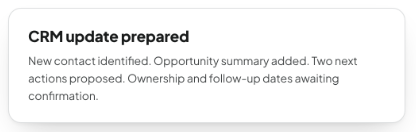
It’s hard to feel effective when a promising client meeting goes nowhere because we forgot to follow up. By making sure these details are remembered, agents can support people’s sense of competence.
“Leave that decision to me”
Let's return to the unanswered email. For our colleague, that isn’t a problem to fix. It’s often the plan. Nonprofit teams are stretched, and giving them room before checking in again is part of building the relationship. But preparing another message automatically – without the tacit context people bring to those relationships – may go further than they want.
So what should the agent do? When you’re juggling dozens of conversations, it helps to have something flag when it might be time to check back — on our terms, not the tool’s. For example:
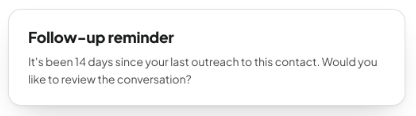
Now consider the weekly briefing. Having to approve every update the agent collects or includes becomes another thing to supervise, defeating the purpose of delegation. Our colleagues saw things differently here. They were happy to let the agent take the lead, gathering and sharing updates without checking in at every step.
What's interesting is that both preferences can support our sense of autonomy. Having meaningful choice doesn't necessarily mean being involved in every decision. Sometimes, it means choosing not to be. For agent design, this means shifting attention beyond the boundaries of a task. Rather than adding approval steps by default, we need to understand when people welcome an agent's initiative and when they'd prefer it to leave the judgement to them.
“Help us look after our relationships”
Evidently, important decisions, questions and commitments often remain buried in meeting transcripts, never quite making it to the colleagues who need them immediately. The information exists, but that doesn't mean everyone who needs it knows about it.
This made us think about the weekly briefing differently. Relationships are easier to nurture when people have a shared understanding of what's happening. Beyond keeping everyone informed, it can help people pick up where a colleague left off, remember what was promised to a partner, or recognise when someone needs support. For example:
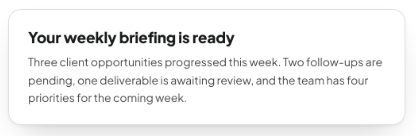
But here’s another dimension to consider. We tend to think personalisation means making technology feel more human: a friendlier tone, a more conversational response, a dash of personality. It’s an easy assumption to make. But it keeps the focus on our relationship with the technology. Designing responsibly for relatedness shifts that focus. It asks the technology to step back and help people maintain meaningful relationships with each other. That is, if you think about it, a much harder design problem (and a far more interesting one).
Bringing these choices into workflow design
It's surprisingly easy to confuse fewer steps with better work. An agent could take over a task, save someone twenty minutes and still leave them wishing they'd done it themselves. Here, the technology hasn’t failed, but has rather taken over something people actually wanted a say in. Competence, autonomy and relatedness offer a way to think through these preferences during workflow discovery. They encourage us to consider whether an agent will help someone work more effectively, preserve the choices they value and support the relationships involved in their work.
At CURA, we want to bring these questions into how we discover and design workflows with clients. Alongside mapping processes and identifying opportunities for automation, we should ask which responsibilities people would welcome handing over, where they want to remain involved and what context an agent should account for.
And that's an important distinction for what we call augmentation. The aim isn't necessarily to give agents more work, but to give people the right kind of help.